🔻 WATCH FULL VIDEO BELOW🔻

The 2015 Dodge Charger SRT Hellcat: A 707-HP American Muscle Sedan Redefining Performance Limits
The automotive landscape of 2015 witnessed a seismic shift in the definition of a production sedan. Dodge, a titan of American muscle, unleashed a vehicle that shattered preconceived notions about power, speed, and practicality: the 2015 Dodge Charger SRT Hellcat. This wasn’t just an update; it was a declaration of war against the status quo. With a staggering 707 horsepower coursing through its veins, this full-size sedan immediately claimed the title of the most powerful production sedan ever conceived. But the audacity didn’t stop there. Chrysler audaciously claimed a top speed of 204 mph, positioning the Hellcat as the fastest production sedan on the planet. What made this achievement even more mind-bending was its four-door configuration. Unlike its two-door sibling, the Challenger SRT Hellcat, which already stunned the automotive world, the Charger brought this earth-shattering performance to a practical, family-friendly chassis.
For automotive enthusiasts who had grown accustomed to the diminishing dominance of Ford’s Shelby GT500 (which had been discontinued) and the supercharged V8 prowess of the Chevrolet Camaro ZL1, the arrival of the Hellcat was nothing short of revolutionary. It represented a return to the raw, unadulterated American muscle ethos, but elevated to an unprecedented level of sophistication and technological might. This wasn’t your grandfather’s muscle car; this was a precision-engineered predator disguised as a comfortable commuter. The 2015 Dodge Charger SRT Hellcat didn’t just enter the market; it redefined the entire segment, setting a benchmark that would influence high-performance sedans for years to come.
The Heart of the Beast: A Supercharged Hemi Masterpiece
At the core of the 2015 Dodge Charger SRT Hellcat’s phenomenal capabilities lies its powertrain—a supercharged 6.2-liter Hemi V8 engine. This powerplant is a testament to engineering audacity, delivering an astonishing 707 horsepower and a colossal 650 lb-ft of torque. What makes this engine particularly noteworthy is its marriage to a single transmission option: an eight-speed automatic transmission sourced from ZF. This transmission was not merely a component; it was a critical enabler of the Hellcat’s performance, engineered to handle the immense power and torque with precision and speed. While the Challenger SRT Hellcat offered a six-speed manual transmission, the Charger’s focus on accessible, high-speed performance made the automatic the perfect choice, ensuring that drivers of all skill levels could harness the car’s prodigious power.
The choice of the ZF eight-speed automatic was a strategic masterstroke. This transmission, known for its rapid shift times and robust construction, was capable of managing the Hemi’s 707 horsepower without breaking a sweat. In the context of 2015, where manufacturers were increasingly turning to dual-clutch transmissions for their performance credentials, Dodge’s decision to rely on a torque-converter automatic was a bold statement. It underscored the car’s identity as a true American muscle machine, prioritizing brutal, accessible acceleration over the sometimes-jerky engagement of a dual-clutch system. This powertrain combination delivered a driving experience that was both savage and surprisingly refined, a dichotomy that would become the hallmark of the Hellcat legend.
Wheels and Tires: The Grip Challenge
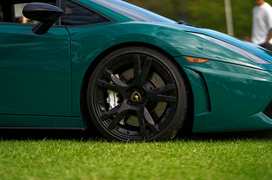
A crucial aspect of the 2015 Dodge Charger SRT Hellcat’s performance equation is its wheel and tire setup. The car rides on 20-by-9.5-inch forged wheels, shod with 275/40R20 Pirelli P Zero tires at all four corners. On paper, these tire dimensions might seem generous for a performance car. However, when considered in the context of the Hellcat’s 707 horsepower, they begin to look conspicuously narrow. To truly appreciate this engineering challenge, one must look back at automotive history. The 305-horsepower 1999-2002 Camaro Z28 came standard with 245/50R16 tires, with 275/40R17s as an option. Even the more powerful 325-horsepower Camaro SS and the 390-horsepower 2003-2004 Ford Mustang Cobra SVT utilized 275/40R17s as their standard tire size. The Hellcat, making roughly double the power of those legendary pony cars, was relying on tires that were, in relative terms, quite modest.
This seemingly conservative tire choice presented a significant hurdle for the Hellcat’s performance, particularly in straight-line acceleration. The massive torque output of the supercharged Hemi often overwhelmed the available grip, especially from a standstill. This limitation would become a recurring theme in the testing of this remarkable machine, highlighting the ongoing battle between raw power and traction in the pursuit of ultimate performance. It was a visual and mechanical reminder that even with 707 horsepower, the laws of physics demanded respect, and the right tires were just as crucial as the engine.
Dragstrip Dominance Tested
The 2015 Dodge Charger SRT Hellcat’s performance at the dragstrip provided a fascinating case study in the relationship between horsepower and traction. Despite its colossal 4,562-pound curb weight, the Hellcat managed to achieve impressive, albeit somewhat compromised, acceleration figures. The car was capable of reaching 60 mph in a remarkable 3.7 seconds, a feat that few sedans, let alone ones weighing this much, could even contemplate. The quarter-mile run was equally compelling, with the Hellcat completing the distance in 11.8 seconds at a trap speed of 124.3 mph. These numbers were undeniably fast, placing the Charger SRT Hellcat firmly in the realm of elite performance vehicles.

However, a direct comparison with its two-door sibling, the 2015 Dodge Challenger SRT Hellcat, immediately highlighted the impact of the tire and weight differences. The Challenger, being 113 pounds lighter and sharing the same engine and transmission, matched the Charger’s 0-60 mph time. More tellingly, the Challenger edged out the Charger in the quarter mile, finishing one-tenth of a second quicker and at a slightly higher trap speed of 125.4 mph. This seemingly small margin underscored the critical role that weight distribution and tire contact patch play in optimizing acceleration. While the Charger was a formidable force on the dragstrip, the data suggested that it was leaving a fraction of its potential performance on the table due to these physical constraints.
Dodge itself claimed that the Charger Hellcat could achieve a quarter-mile time of 11.0 seconds flat. While this might be theoretically possible on a specially prepared dragstrip with optimal conditions and traction-enhancing additives, it was clear that on a standard street-style surface, such a time was largely aspirational. To put these figures into a broader context, one could look to the performance of the Jaguar F-Type V8 S and R models from the same era. These 488-550-horsepower rear-wheel-drive roadsters and coupes, weighing significantly less (3,873-3,965 pounds) and equipped with wider 295/35R20 tires, could achieve 60 mph in the 3.4-3.9 second range and complete the quarter mile in 11.6-12.1 seconds at speeds of 120.2-122.3 mph. The Hellcat, despite its massive power advantage, was trading blows with these lighter, more nimble sports cars, further emphasizing the impact of its curb weight and tire limitations on its ultimate straight-line performance.
The All-Wheel-Drive Advantage: A Tale of Two Systems
The comparison with all-wheel-drive (AWD) performance cars further illuminated the 2015 Dodge Charger SRT Hellcat’s unique position in the automotive hierarchy. The Nissan GT-R, a benchmark for AWD performance, offered a stark contrast in how power was delivered to the pavement. The last three GT-R models tested by automotive publications, including the Black Edition, Track Pack, and Nismo variants, all boasted between 545 and 600 horsepower. These vehicles could achieve 60 mph in a blistering 2.7-2.9 seconds and complete the quarter mile in 11.0-11.1 seconds at trap speeds of 124.8-125.3 mph. The key differentiator was the GT-R’s sophisticated all-wheel-drive system, which, combined with its shorter transmission gearing and lower curb weight (3,880-3,887 pounds), allowed it to harness its power far more effectively than the rear-wheel-drive Hellcat.
The GT-R’s performance numbers clearly indicated that the Hellcat’s tires were a significant limiting factor. The superior traction provided by the GT-R’s AWD system allowed it to launch with authority, translating its horsepower into significantly quicker acceleration figures. While the Hellcat could achieve a higher top speed, its ability to get off the line quickly was hampered by the sheer volume of torque being sent to the rear wheels. This comparison wasn’t intended to diminish the Hellcat’s achievements; rather, it served to highlight the engineering trade-offs inherent in its design. The Hellcat prioritized raw, accessible, rear-wheel-drive muscle, even if it meant sacrificing some straight-line performance to AWD competitors.

The